
Lifespan, Long-Term Value, and Whether They’re Actually Worth It
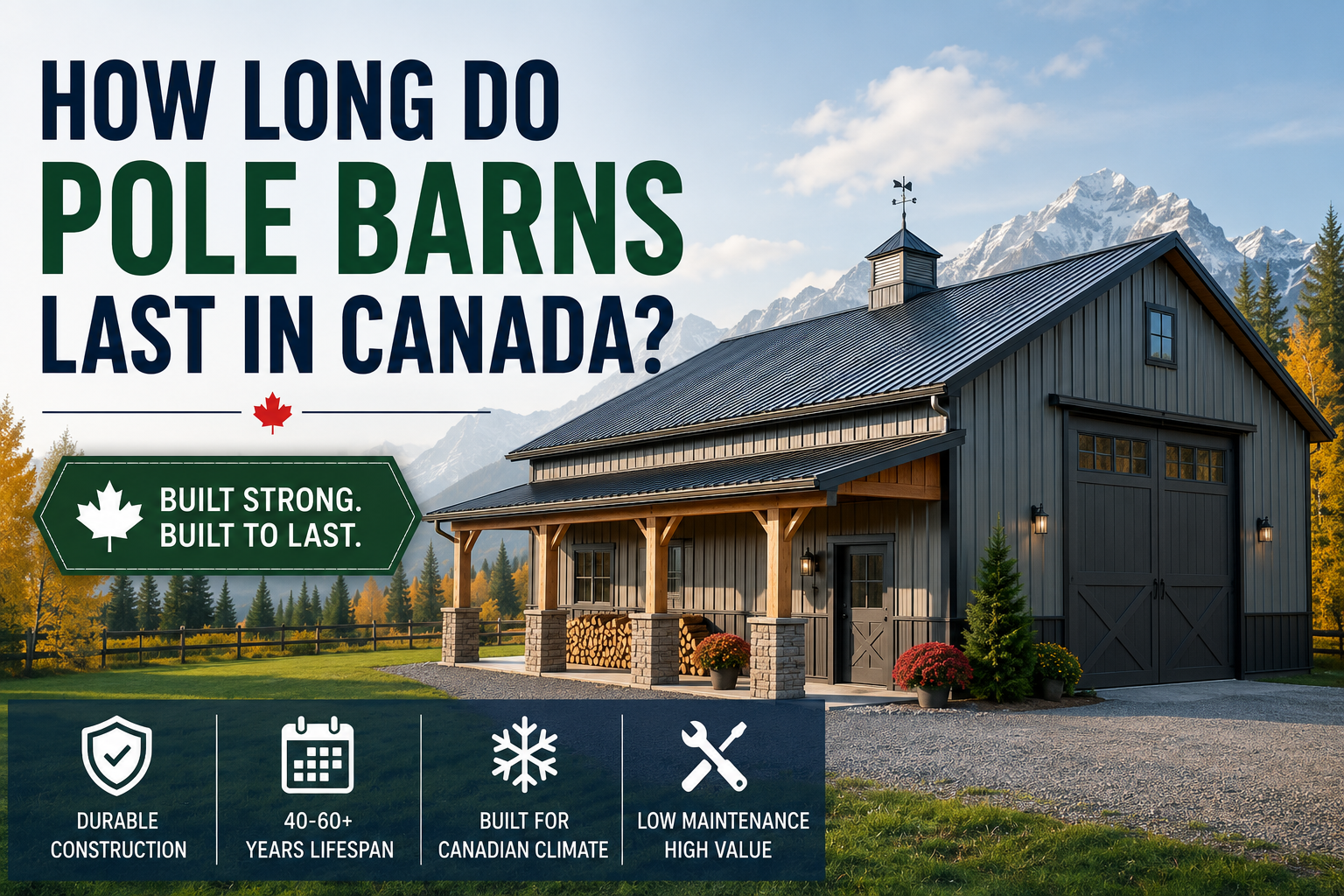
Quick Answer: A well-built pole barn in Canada typically lasts 40 to 60 years, and many exceed that with basic maintenance. The wood posts and steel cladding are the main factors in longevity. With proper drainage, quality materials, and periodic upkeep, a pole barn is one of the most cost-effective, long-lasting building types available to Canadian property owners — making it well worth the investment for most agricultural, storage, and workshop uses.
If you’ve already looked into pole barn costs, the next question is the one that really matters: how long will it actually last, and is it worth the money? A building is only a good deal if it stands the test of time, and that’s especially true in Canada, where structures face heavy snow, freeze-thaw cycles, and demanding weather year-round. This guide answers both questions directly — with real Canadian lifespan numbers, the factors that make the biggest difference, an honest comparison against other building types, and a clear look at when a pole barn is the right call versus when it isn’t.
How Long Do Pole Barns Last on Average?
A properly constructed pole barn lasts 40 to 60 years on average in the Canadian climate. That’s the realistic working lifespan of the structure as a whole. Individual components, however, age at different rates — and knowing which parts last longest helps you plan maintenance and understand the true long-term value.
| Component | Typical Lifespan | Notes |
| Pressure-treated posts | 40–60+ years | The critical structural element |
| Steel roofing & siding | 40–70 years | Depends on coating & gauge |
| Trusses & framing | 50+ years | Rarely the failure point |
| Concrete floor (optional) | 50+ years | Effectively permanent |
| Fasteners & screws | 20–40 years | May need re-tightening over time |
The takeaway: a pole barn doesn’t usually “expire” all at once. With occasional attention to fasteners and cladding, the core structure can outlive the owner who built it.
What Determines How Long a Pole Barn Lasts?
Five factors have the biggest impact on the lifespan of a pole barn in Canada. Getting these right at the build stage is what separates a 30-year barn from a 60-year one.
1. Post Quality and Protection
The posts are the foundation of the entire structure. Modern pole barns use pressure-treated laminated columns or install posts on concrete brackets that keep wood out of direct ground contact. This single detail dramatically reduces rot — historically the number-one cause of pole barn failure.
2. Drainage and Site Preparation
Water is the enemy of any building. A pole barn built on a properly graded, well-drained site — with the base pad raised above the surrounding grade — keeps moisture away from the posts and floor. Poor drainage is the fastest way to shorten a barn’s life, regardless of build quality.
3. Roofing and Cladding Grade
Not all steel is equal. Heavier-gauge panels with quality galvanized or Galvalume coatings resist the freeze-thaw cycles, road salt, and heavy snow loads common across Canada. Investing in better cladding up front adds decades to the exterior’s life.
4. Snow Load Engineering
Canadian pole barns must be engineered for regional snow loads — which vary widely between, say, southern Ontario and the Prairies or mountain regions. A barn correctly rated for its local load carries winter weight for decades; an under-built one accumulates stress that shortens its life.
5. Maintenance Habits
Pole barns are famously low-maintenance, but “low” isn’t “none.” A short annual check keeps small issues from becoming structural ones. More on that below.
Ready to explore your options? Contact PFP Buildings for a consultation and a detailed quote tailored to your property and needs.
Are Pole Barns Worth It? An Honest Look
For the large majority of Canadian buyers — farmers, rural property owners, tradespeople, and anyone needing storage, equipment shelter, or workshop space — a pole barn is genuinely worth it. Here’s the balanced case.
Where Pole Barns Deliver Strong Value
- Lower cost per square foot than almost any comparable enclosed building.
- Faster construction — fewer materials and simpler foundations mean quicker builds.
- Large clear-span interiors with no interior posts, ideal for equipment and vehicles.
- Long lifespan relative to upfront cost — the core reason the value proposition is so strong.
- Flexible use: storage, livestock, workshops, garages, riding arenas, and more.
Where a Pole Barn May Not Be the Right Fit
An honest guide names the exceptions. A pole barn may not be ideal if you need a fully climate-controlled commercial space, a multi-storey structure, or a building on a site with severe drainage problems that can’t be corrected. In those cases, a different building system may serve you better — and a reputable builder will tell you so. For the vast majority of rural and agricultural applications, however, none of these limitations apply, and the pole barn remains the clear front-runner on both cost and durability.
| Value Verdict Judged on lifespan-per-dollar, pole barns are one of the best-value building types in Canada. A structure that costs a fraction of conventional construction yet lasts half a century delivers a return that’s hard to beat for agricultural and storage use. |
How Does a Pole Barn’s Lifespan Compare to Other Buildings?
One of the most common questions Canadian buyers ask is how a pole barn stacks up against other building types over the long run. Here’s how the main options compare on lifespan, cost, and upkeep:
| Building Type | Typical Lifespan | Relative Cost |
| Pole barn (post-frame) | 40–60+ years | Lowest |
| Steel / metal building | 40–70 years | Higher |
| Traditional stick-frame | 50–80 years | Highest |
| Prefab metal shed | 15–30 years | Low, but shorter life |
The pattern is clear: pole barns deliver a lifespan close to far more expensive building systems, at the lowest cost of the enclosed options. A steel building may edge out a pole barn on raw longevity, but usually at a meaningfully higher price — and a pole barn can be insulated and finished to serve most of the same purposes. For agricultural and storage use especially, the cost-to-lifespan ratio is where post-frame construction wins.
It’s also worth noting that pole barns are easier and cheaper to modify or expand later. Because the structure relies on posts rather than continuous load-bearing walls, adding a lean-to, extending the length, or cutting in new doors is far simpler than with other systems — which protects your investment as your needs change over the decades.
How to Make a Pole Barn Last Longer
Want to push your barn toward the upper end of that 40–60 year range — or beyond? These maintenance habits make the difference:
- Inspect annually. Walk the structure once a year, checking posts, fasteners, and roofline for any movement or wear.
- Keep drainage clear. Ensure water always flows away from the base; clear gutters and grade as needed.
- Re-tighten fasteners. Screws can loosen over decades of expansion and contraction — a quick pass restores the seal.
- Address rust early. Touch up any scratches or rust spots on steel before they spread.
- Manage snow load. In heavy-snow regions, monitor accumulation on the roof during extreme winters.
None of this is expensive or time-consuming — and it’s exactly what turns a good barn into one that lasts generations. Think of it the way you’d treat any major asset: a small, predictable amount of attention each year prevents the large, unpredictable repair bills later. Most owners spend no more than an afternoon a year on upkeep, and that modest effort is repaid many times over in extended lifespan and retained property value.
Frequently Asked Questions
Do pole barns last as long as traditional buildings?
In many cases, yes. A quality pole barn’s 40–60 year lifespan is comparable to many conventional outbuildings, often at a significantly lower cost — which is why the value comparison so often favours the pole barn.
What is the most common reason pole barns fail?
Post rot from moisture and poor drainage is historically the leading cause. Modern bracket-mounted or pressure-treated posts, combined with good site drainage, have largely solved this.
Can a pole barn handle Canadian winters?
Absolutely — when engineered for the local snow load. Canadian pole barns are routinely built to withstand heavy snow and freeze-thaw cycles across every region.
Does a pole barn add value to a property?
Yes. A well-built pole barn adds usable, versatile space that appeals to rural and agricultural buyers, making it a practical long-term investment in your property.
How much maintenance does a pole barn need?
Very little — an annual inspection, drainage checks, and occasional fastener re-tightening are enough to keep it sound for decades.
Build a Pole Barn That Lasts
The difference between a 30-year barn and a 60-year one comes down to engineering, materials, and construction quality. At PFP Buildings, we design and build Canadian pole barns engineered for local snow loads and built to last generations — with the durable materials and proper site preparation that protect your investment for decades.
Ready to explore your options? Contact PFP Buildings for a consultation and a detailed quote tailored to your property and needs.